
Living in Dubai means enjoying sunshine almost every day of the year. But year-round sun exposure also means your skin is regularly exposed to ultraviolet (UV) radiation, which can contribute to sunburn, premature skin aging, pigmentation, and long-term skin damage.
That is why sun protection in Dubai should not be limited to beach days or the hottest summer months. Daily sunscreen, shade, protective clothing, and smart sun habits should be part of your skincare routine throughout the year.
Whether you are driving to work, sitting near a sunny window, walking outdoors, or spending time at the beach, consistent protection can help keep your skin healthier and reduce cumulative UV damage.
Why Is Sun Protection in Dubai So Important?
Dubai’s sunny climate makes UV protection relevant throughout the year.
UV radiation is invisible, which means your skin can still be exposed even when the weather feels comfortable or the sky appears cloudy.
Regular UV exposure can contribute to:
- Sunburn
- Fine lines and wrinkles
- Premature skin aging
- Dark spots
- Uneven skin tone
- Hyperpigmentation
- Loss of skin elasticity
- Increased risk of skin cancer
For this reason, sun protection in Dubai should be treated as an everyday habit rather than an occasional skincare step.
The American Academy of Dermatology recommends broad-spectrum, water-resistant sunscreen with SPF 30 or higher when protecting exposed skin outdoors.
Table of Contents
Understanding UVA and UVB Rays
Sunlight contains different types of ultraviolet radiation. The two most important for everyday skin protection are UVA and UVB.
UVA Rays
UVA rays are strongly associated with premature skin aging and can contribute to wrinkles and age spots.
They can also pass through ordinary window glass, which means exposure can occur while driving or sitting close to sunny windows.
This is particularly relevant in Dubai, where many people spend significant time driving between work, home, shopping centers, and other locations.
UVB Rays
UVB rays are the main cause of sunburn.
Unlike UVA, UVB is largely blocked by ordinary window glass. However, both UVA and UVB contribute to cumulative skin damage.
That is why choosing a broad-spectrum sunscreen is important: broad-spectrum products are designed to protect against both UVA and UVB radiation.
How Dubai’s Climate Can Affect Your Skin
Sunlight is only one part of the environmental challenge your skin faces in Dubai.
Heat, humidity, air conditioning, outdoor activities, and frequent transitions between hot outdoor environments and cool indoor spaces can all influence how the skin feels.
Some people may notice:
- Dryness
- Dehydration
- Increased oiliness
- Sensitivity
- Dullness
- Uneven skin tone
- A compromised-feeling skin barrier
For a deeper look at how the regional environment can influence your skin, read our guide on How the Gulf Climate Affects Your Skin.
If dryness is one of your main concerns, our guide to Dry Skin Treatment in Dubai explains common causes and skin-barrier care in more detail.
Sun Exposure and Pigmentation
Pigmentation is a particularly important concern in sunny climates.
UV exposure can worsen existing dark spots and may contribute to uneven pigmentation over time.
People concerned about:
- Melasma
- Post-inflammatory hyperpigmentation
- Acne marks
- Sun spots
- Uneven skin tone
should pay close attention to consistent sun protection.
Daily sun protection is also an important part of melasma care. The American Academy of Dermatology recommends SPF 30 or higher, shade, protective clothing, and regular sunscreen reapplication for people with melasma.
If pigmentation is already a concern, you may also find our guide to Pigmentation Treatment in Dubai useful.
What Does SPF Mean?
SPF stands for Sun Protection Factor.
It mainly indicates how well a sunscreen protects against UVB radiation when applied correctly.
Dermatologists generally recommend using sunscreen with SPF 30 or higher. SPF 30 filters about 97% of UVB rays when used as directed, while higher SPF values provide somewhat greater UVB protection.
However, higher SPF does not mean you can apply less sunscreen or stay in the sun indefinitely.
Correct application and reapplication still matter.
SPF 30 vs SPF 50: Which Should You Choose?
Both SPF 30 and SPF 50 can provide strong protection when applied correctly.
For many everyday situations, SPF 30 may be suitable.
SPF 50 can be a practical option for people who:
- Spend long periods outdoors
- Exercise outdoors
- Visit the beach or pool
- Burn easily
- Have pigmentation concerns
- Are following aftercare after certain aesthetic treatments
The most important point is consistency.
A sunscreen that feels comfortable on your skin and fits easily into your routine is more likely to be used properly every day.
Choose Broad-Spectrum Sunscreen
When shopping for sunscreen, look for the words:
Broad Spectrum
Broad-spectrum sunscreen protects against both UVA and UVB radiation.
This is especially important for sun protection in Dubai, because avoiding sunburn alone is not enough.
UVA exposure can also contribute to premature aging and pigmentation.
Mineral vs Chemical Sunscreen
Sunscreens are commonly described as mineral or chemical.
Both types can provide effective sun protection when properly formulated and applied correctly.
Mineral Sunscreens
Mineral formulas commonly contain:
- Zinc oxide
- Titanium dioxide
Some people with sensitive skin prefer mineral sunscreens.
Depending on the formula, they may occasionally leave a visible white cast, particularly on deeper skin tones.
Chemical Sunscreens
Chemical sunscreens use organic UV filters and are available in many textures.
They may feel lighter or blend more easily under makeup, which can make them convenient for everyday use.
There is no single sunscreen formula that is best for everyone.
The right choice depends on your:
- Skin type
- Sensitivity
- Lifestyle
- Personal preference
- Makeup routine
How Much Sunscreen Should You Apply?
Using too little sunscreen is one of the most common mistakes.
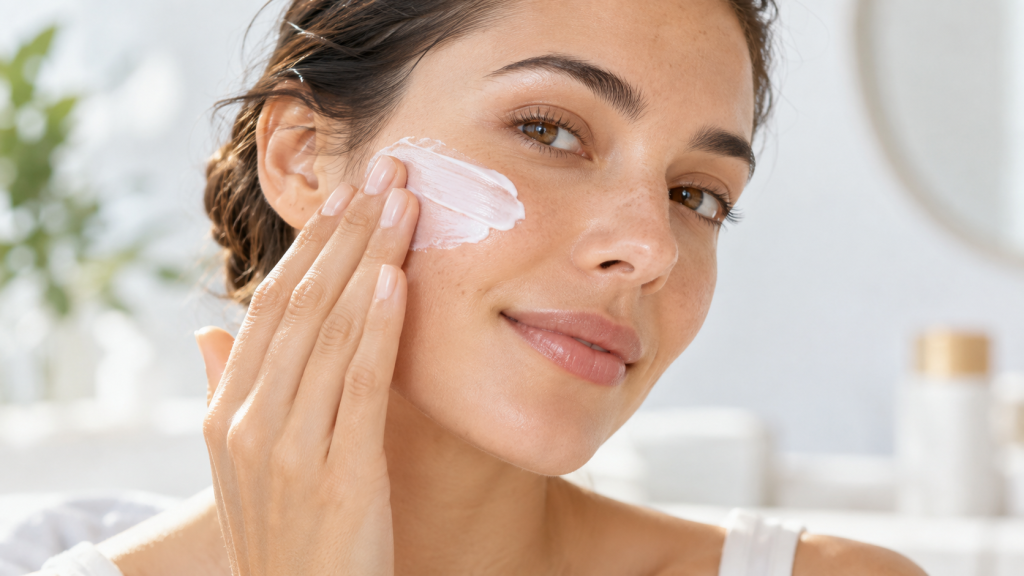
Sunscreen should be applied generously and evenly to all exposed skin.
The American Academy of Dermatology notes that most adults need approximately one ounce—about enough to fill a shot glass—to cover exposed body skin.
Do not forget commonly missed areas such as:
- Ears
- Neck
- Upper chest
- Hands
- Arms
- Feet when exposed
For the face and neck, make sure you create an even layer rather than applying sunscreen only over areas where pigmentation is visible.
When Should You Apply Sunscreen?
Sunscreen should be applied before going outdoors.
AAD guidance recommends applying sunscreen approximately 15 minutes before sun exposure.
A simple morning skincare routine may be:
- Gentle cleanser
- Treatment serum, if appropriate
- Moisturizer
- Sunscreen
- Makeup, if desired
Sunscreen should generally be the final skincare step before makeup.
How Often Should You Reapply Sunscreen?
When spending time outdoors, sunscreen should generally be reapplied approximately every two hours.
You should also reapply after:
- Swimming
- Heavy sweating
- Toweling the skin
- Extended outdoor activity
Water-resistant sunscreens also have specific water-resistance periods listed on their labels, so always follow the product instructions.
For effective sun protection in Dubai, reapplication is especially important during beach days, outdoor exercise, sightseeing, and other prolonged outdoor activities.
Do You Need Sunscreen Indoors?
It depends on your environment.
If you spend the entire day well away from windows, your exposure may be limited.
However, daily sunscreen can still be useful if you:
- Sit beside sunny windows
- Drive frequently
- Work beside large windows
- Move between indoor and outdoor spaces
- Spend significant time in daylight
UVA rays can pass through ordinary window glass, so drivers and people working near windows can still receive UVA exposure.
For many people, making sunscreen part of the morning routine is easier than constantly calculating daily exposure.
Do You Need Sunscreen on Cloudy Days?
Yes.
Cloudy weather does not eliminate UV exposure.
If you are going outdoors, maintaining daily sunscreen use is a simple way to keep your routine consistent.
AAD guidance also recommends sun protection on cloudy days.
Sunscreen for Oily Skin
People with oily or acne-prone skin sometimes avoid sunscreen because they worry about shine, heaviness, or clogged pores.
Look for formulas described as:
- Lightweight
- Non-comedogenic
- Oil-free
- Fluid
- Gel-based
- Matte finish
Oily skin still needs protection from UV radiation.
If excess oil and shine are ongoing concerns, see our Best Skincare Routine for Oily Skin for a more complete routine.
Sunscreen for Dry Skin
Dry skin often benefits from a sunscreen with a more moisturizing texture.
You can also apply an appropriate moisturizer underneath your sunscreen.
Look for a routine that protects the skin without making dryness, tightness, or irritation worse.
For more information, read Dry Skin Treatment in Dubai.
Sunscreen for Sensitive Skin
Sensitive skin often benefits from a simpler skincare routine.
Introduce new products gradually and pay attention to symptoms such as:
- Burning
- Stinging
- Redness
- Itching
- Persistent irritation
If a sunscreen repeatedly causes irritation, stop using it and consider a formula better suited to sensitive skin.
Our guide to Sensitive Skin in Dubai: Signs, Triggers & Care Guide explains how environmental factors and skincare habits can influence sensitive skin.
What About Tinted Sunscreen?
Tinted sunscreen can be especially helpful for people concerned about pigmentation.
Visible light can contribute to hyperpigmentation in some people, particularly those with darker skin tones.
Tinted sunscreens containing iron oxide can provide additional protection against visible light.
This can be particularly useful for people with:
- Melasma
- Post-inflammatory hyperpigmentation
- Dark spots
- Uneven skin tone
If pigmentation is a major concern, consider choosing a broad-spectrum tinted sunscreen with SPF 30 or higher.
Sunscreen and Makeup
Sunscreen should generally be applied underneath makeup.
Allow it to settle into an even layer before applying foundation or other cosmetics.
Some moisturizers and makeup products contain SPF, but sunscreen still needs to be applied in an adequate amount and reapplied when appropriate.
For this reason, using a dedicated sunscreen underneath makeup is often the most practical approach.
Common Sunscreen Mistakes
Even a good sunscreen cannot provide its intended protection when used incorrectly.
Using Too Little
A thin or uneven layer may provide less protection than expected.
Forgetting to Reapply
One morning application may not be enough during long periods outdoors.
Missing the Neck and Ears
These areas often receive significant sun exposure but are frequently forgotten.
Relying Only on Makeup with SPF
Makeup can complement your sun-protection routine, but it should not automatically replace adequately applied sunscreen.
Skipping Sunscreen in Cooler Weather
Lower temperatures do not mean UV radiation disappears.
Assuming High SPF Lasts Longer
High-SPF sunscreen does not last longer than lower-SPF sunscreen. Reapplication is still necessary.
Sunscreen Is Only One Part of Sun Protection
Sunscreen is important, but it should not be your only form of protection.
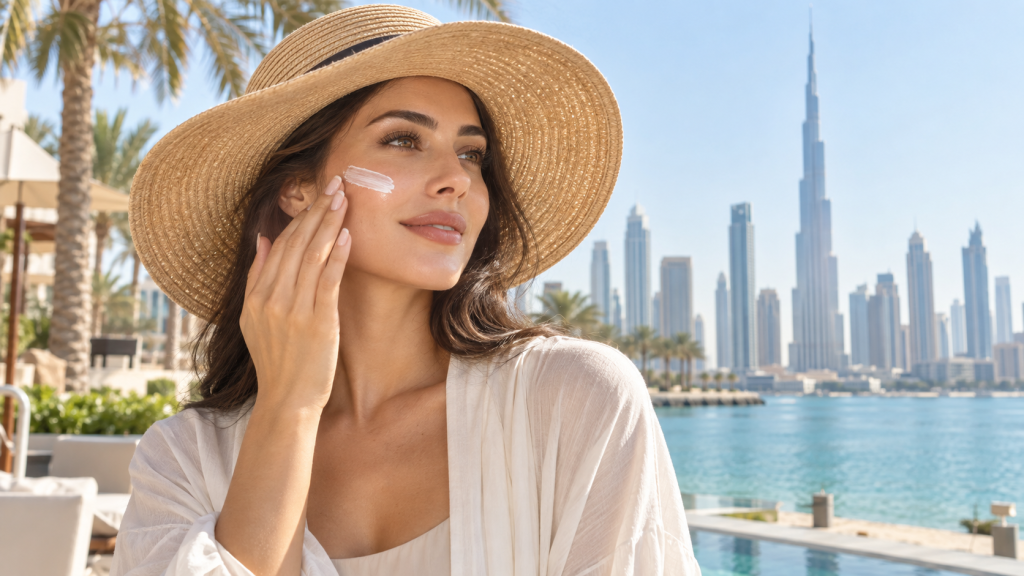
For more complete protection, combine sunscreen with:
- Shade
- Sunglasses with UV protection
- A wide-brimmed hat
- Protective clothing
- Reduced prolonged direct sun exposure
AAD guidance recommends combining sunscreen with shade and sun-protective clothing rather than relying on sunscreen alone.
Sun Protection After Aesthetic Treatments
Sun protection becomes particularly important after certain cosmetic treatments.
Depending on the procedure, freshly treated skin may temporarily be more sensitive to environmental exposure or pigmentation.
Your practitioner may recommend careful sun protection after treatments such as:
- Chemical peels
- Laser procedures
- Microneedling
- RF microneedling
- Skin resurfacing procedures
If you are considering RF Microneedling in Dubai, following the recommended aftercare—including sun protection—is an important part of recovery.
Sun Protection and Anti-Aging Skincare
Many people invest in anti-aging treatments while overlooking one of the most important preventive habits: sun protection.
UV exposure contributes to visible skin aging, including wrinkles and age spots.
Daily sunscreen can support the rest of an anti-aging routine that may include:
- Moisturizer
- Antioxidants
- Retinoids when appropriate
- Professional treatments
- Skin-barrier care
The goal is not only to treat existing signs of aging but also to reduce avoidable additional UV damage.
A Simple Daily Sun Protection Routine in Dubai
You do not need an overly complicated skincare routine.
Morning
- Cleanse gently.
- Apply suitable treatment products.
- Moisturize if your skin needs it.
- Apply broad-spectrum SPF 30 or higher.
- Apply makeup if desired.
During the Day
Reapply sunscreen when appropriate, especially during prolonged outdoor exposure.
Use shade, sunglasses, protective clothing, and a hat when possible.
Evening
Cleanse the skin properly to remove sunscreen, makeup, sweat, and daily buildup.
Follow with your usual evening skincare routine.
Frequently Asked Questions
Is SPF 30 enough in Dubai?
SPF 30 can provide strong UVB protection when applied correctly. Dermatologists recommend SPF 30 or higher, while SPF 50 may be preferred by people with significant outdoor exposure or pigmentation concerns.
Should I use SPF 50 every day in Dubai?
You can use SPF 50 every day if the formula suits your skin. The most important factors are broad-spectrum coverage, adequate application, and consistent use.
How often should I reapply sunscreen?
When outdoors, sunscreen should generally be reapplied approximately every two hours and after swimming or sweating.
Do I need sunscreen while driving?
UVA rays can pass through ordinary window glass, so sun protection can be useful for people who spend significant time driving.
Do I need sunscreen on cloudy days?
Yes. Cloud cover does not eliminate UV exposure, so sun-protection measures are still recommended outdoors.
Is sunscreen necessary during winter in Dubai?
Yes. Sun protection in Dubai should be considered year-round rather than only during the hottest months.
Can sunscreen help with pigmentation?
Sunscreen can help reduce additional UV-triggered pigmentation. Consistent protection is especially important for concerns such as melasma and dark spots.
Is tinted sunscreen better for pigmentation?
Tinted sunscreens containing iron oxide can provide additional protection from visible light, which may worsen pigmentation in some people.
Is SPF in foundation enough?
Makeup with SPF can contribute to protection, but a dedicated sunscreen applied in an adequate amount is generally a more reliable foundation for a daily sun-protection routine.
Which sunscreen is best for sensitive skin?
There is no single formula that works for everyone. Choose a sunscreen that feels comfortable, suits your skin type, and does not repeatedly cause burning, stinging, or irritation.
Why Consistency Matters
The best sunscreen is not necessarily the most expensive one.
It is a sunscreen that:
- Provides broad-spectrum protection
- Has SPF 30 or higher
- Feels comfortable on your skin
- Works with your daily routine
- Is easy to apply consistently
- Can be reapplied when needed
A product you actually use correctly every day is more useful than one you rarely apply.
Make Sun Protection Part of Your Everyday Routine
Sun protection in Dubai is important throughout the year, not just during summer or beach days.
Using broad-spectrum sunscreen together with shade, protective clothing, sunglasses, and sensible sun habits can help reduce cumulative UV damage, premature skin aging, and pigmentation.
Your skin type, lifestyle, current treatments, and pigmentation concerns should all be considered when choosing the right sunscreen and skincare routine.
At Derma One, a personalized skin assessment can help you understand your skin’s individual needs and build a routine designed to support healthy, protected, and radiant-looking skin throughout the year.

6 Comments
[…] of life in the UAE, plan the appointment around beach days, outdoor work and travel. Our guide to sun protection in Dubai explains how consistent SPF use fits into year-round skincare in the local […]
[…] For more local skincare advice, read How the Gulf Climate Affects Your Skin and Sun Protection in Dubai. […]
[…] strong sunlight makes a sensible daily sunscreen routine particularly useful; see our guide to sun protection in Dubai. Your clinician should tell you when to resume makeup, active skincare, strenuous exercise, or […]
[…] guide to sun protection in Dubai explains why year-round protection […]
[…] can also read our guide to Sun Protection in Dubai | Why SPF Is Non-Negotiable All Year for more information about protecting your skin in the UAE […]
[…] sun protection guide for Dubai offers practical advice for daily care. Contact the clinic promptly if pain or redness worsens, or […]